The Fire Service Built a Promotional Prep System.
EMS Finally Has One.
EMS promotional assessments are built exactly like fire boards — but every prep system was built for fire. Until now. The Promotional Standard is the first NEMSMA-aligned, methodology-driven preparation system built exclusively for EMS officers testing from Lieutenant through Chief.
The EMS Officer Program
The complete 13-chapter EMS track — plus the full 43-chapter Fire officer curriculum it was built alongside.
- · All 13 EMS-track chapters — Supervising through Executive Officer
- · All 43 Fire-track chapters — the complete TPS library
- · The Halligan practice engine — 90-day practice window
See What Deliberate Preparation Looks Like.
3 minutes. No signup required.
The Preparation Gap
Every system was built for fire.
You've been using it anyway.
EMS promotional assessments test the same formats — oral boards, in-baskets, role plays — but the scenarios, the competencies, and the expected answers are fundamentally different. Fire systems teach you to talk like a captain. Your board wants to know if you can lead a system.
NEMSMA identified seven pillars of EMS leadership development. No preparation program was built around them. Until now.
The Promotional Standard is the first EMS preparation system aligned to the NEMSMA framework — built from Lieutenant through Chief, for the EMS officer track specifically.
The Problem
You've Been Preparing With the Wrong System.
EMS promotional assessment centers are structured identically to fire service boards — the same question buckets, the same behavioral anchors, the same scoring rubrics. But every promotional prep resource ever built was designed for fire candidates. EMS officers have been borrowing fire service frameworks, studying fire-specific scenarios, and walking into boards that assess EMS leadership competencies with tools that were never built for them.
That's not a preparation gap. That's a system gap. And until now, nobody filled it.
Results
FIRST EMS RESULT INCOMING
Placeholder — first pass rate and testimonials coming soon.
The EMS Leadership Curriculum
Three Identity Shifts.
Thirteen Chapters.
Lieutenant Through Chief.
Most candidates study topics. This curriculum builds officers. Each phase is structured around a fundamental identity shift — the kind your board is actually trying to evaluate.
Phase 1 — Supervising EMS Officer
Chapters 1–6
The first shift: from provider to supervisor. Crew leadership, field supervision, EMS personnel management, scene leadership, self-attributes, and the foundational TPS framework library.
Ch. 1 The EMS Officer System · Ch. 2 Self Attributes · Ch. 3 Leading Others · Ch. 4 Field Supervision Fundamentals · Ch. 5 EMS Personnel Leadership · Ch. 6 EMS Scene Leadership
Phase 2 — Managing EMS Officer
Chapters 7–10
The second shift: from supervisor to system leader. Strategic planning, budget development, EMS quality management, and labor relations with HR strategy.
Ch. 7 Strategic Planning & Innovation · Ch. 8 Budget Development & Financial Leadership · Ch. 9 EMS Quality Management · Ch. 10 Labor Relations, HR Strategy & Workforce
Phase 3 — Executive EMS Officer
Chapters 11–13
The third shift: from manager to executive. Governance, advocacy, data analytics, performance management, and the complete oral board scenario bank with integrated fire and EMS frameworks.
Ch. 11 The Executive Officer Track · Ch. 12 EMS Data Analytics & Performance Management · Ch. 13 Oral Board Scenario Bank
The Framework Behind the Curriculum
Built on the Only National Standard
EMS Leadership Has Ever Had.
In 2014, NEMSMA published the Seven Pillars of National EMS Officer Competencies — the first document in EMS history to define what excellent leadership actually looks like at every level, from front-line supervisor to chief. Every chapter of this curriculum is built against that framework.
Prerequisites
The operational and academic baseline for each officer level. Chapter 1 establishes your identity as an EMS officer and what that rank actually requires.
Ch. 1 — The EMS Officer System
Self Attributes
Work habits, stress management, self-insight, and continuous learning. Chapter 2 builds the internal foundation your board will test whether they call it that or not.
Ch. 2 — Self Attributes
Leading Others
Communication, interpersonal awareness, motivation, developing others, influence. Built directly against this pillar across two dedicated chapters.
Ch. 3 Leading Others · Ch. 5 EMS Personnel Leadership
Task Management
Executing tasks, solving problems, managing information and resources, emergency service delivery. Applied at field, scene, and financial stewardship levels.
Ch. 4 Field Supervision · Ch. 6 EMS Scene Leadership · Ch. 8 Budget & Financial Leadership
Innovation
Creativity, forecasting, managing change, integrating perspectives. The direct application at the Managing Officer level.
Ch. 7 — Strategic Planning & Innovation
Social Responsibility
Ethical processes, community relations, government affairs, acting with integrity, health and safety. Applied to quality management and the labor landscape an officer navigates daily.
Ch. 9 EMS Quality Management · Ch. 10 Labor Relations & HR Strategy
Clinical Performance
Quality and performance management, education and learning systems. Clinical accountability brought into the executive officer frame.
Ch. 12 EMS Data Analytics · Ch. 13 Oral Board Scenario Bank
No other EMS promotional prep system was built against this framework. Every chapter, every scenario, every exercise type is mapped to a pillar — because your board is evaluating exactly these competencies, whether they've read the document or not.
The Analytical Framework
Every EMS Scenario Has a Structure.
This Is How You Find It.
Oral boards don't test what you know. They test how you think under pressure. LEAD is the four-step analytical framework built into every TPS chapter — a consistent approach that works across every scenario type, every rank, every format.
LABEL THE BUCKET
Before you answer, identify what kind of problem this actually is. A crew performance scenario and a resource allocation scenario demand different frameworks, different language, and different values on display. EMS boards routinely disguise one type of problem as another. Label it first.
Common EMS buckets: crew conflict, clinical quality, scene leadership, budget/resource, community relations, HR/discipline, system design, protocol deviation.
ENGAGE THE FORMAT
Every response needs a delivery structure. LEAD doesn't prescribe one — it requires you to choose the right one for the scenario in front of you. STAR-P for narrative experience answers. Five-Paragraph Order for operational command scenarios. CALM for conflict and difficult conversation scenarios — the format your EMS board will use most. Four-P when the scenario requires you to frame a problem, present a plan, predict outcomes, and provide a decision.
EMS candidates default to storytelling. The board is scoring your structure.
APPLY THE DIAGNOSTIC
Once you've labeled the bucket and chosen your format, deploy the right analytical lens. The 3 U's sort what needs immediate action from what needs a system fix. Glasl's escalation model tells you where a conflict actually sits — and whether your instinct to intervene is correct. The Eisenhower matrix shows your board that you distinguish between urgent and important before you act.
Using a named framework signals officer-level thinking. It's the difference between a good answer and a promoted answer.
DELIVER AT RANK
Your answer isn't just content — it's a demonstration of identity. Deliver at the rank you're testing for, not the rank you hold. A Lieutenant candidate who answers like a medic doesn't get promoted. An EMS Captain candidate who answers like a Chief gets asked why they're not already one. Close every answer with a value anchor. T·C·H·O·E·D·S — Trust, Courage, Humility, Ownership, Empathy, Dedication, Service — aren't a checklist. They're the vocabulary of the officer you're claiming to be.
Using a named framework signals officer-level thinking. It's the difference between a good answer and a promoted answer.
LEAD IS EMBEDDED IN EVERY CHAPTER, EVERY EXERCISE TYPE, EVERY AI-COACHED REP.
Every Exercise Type · 8 Bars Dimensions
Every Format Your Board
Can Put in Front of You.
EMS promotional assessments use the same exercise formats as fire — but the scenarios are different, the competencies being scored are different, and the expected answers are different. This curriculum trains every exercise type.
Oral Board
The core format. A panel, a scenario, a clock. EMS boards test clinical judgment, crew leadership, and system-level thinking in the same sitting. LEAD keeps your answer structured when the pressure is highest.
Role Play
You're in the scenario, not describing it. A difficult crew member, a family complaint, a protocol deviation conversation. EMS role plays test interpersonal sensitivity and leadership identity simultaneously — the two dimensions most candidates underprep.
In-Basket
A stack of competing priorities lands on your desk. Emails, incident reports, scheduling conflicts, a union grievance, a QI flag. You have limited time and no one to ask. EMS in-baskets test your ability to triage an officer's workload — not a medic's.
Written Exercise
A memo. A policy draft. An after-action report. EMS written exercises test whether you can communicate at rank — clear, concise, and free of the clinical shorthand that marks a provider, not an officer.
Subordinate Counseling
Face to face with a crew member who has a performance problem, an attitude problem, or a clinical concern. EMS counseling scenarios require you to balance just culture, HR awareness, and human empathy at the same time — and do it out loud, in front of evaluators.
Presentation
You have materials, a topic, and a room. EMS presentation scenarios often involve a budget ask, a protocol change, or a quality improvement initiative. Your board is scoring your ability to lead up — not just down.
AI-POWERED PRACTICE ENGINE
Every door has a weakness. Find yours before the board does.
Unlimited reps. Assessor-style behavioral scoring on 8 dimensions, with CLEAR feedback after every rep.
EMS candidates get scenarios built from EMS context — crew dynamics, clinical accountability, system leadership, and the NEMSMA competency framework baked into every rep.
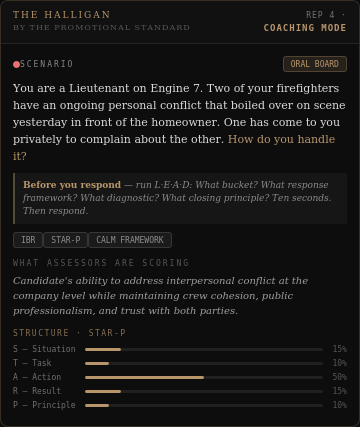
01 · YOUR SCENARIO
Your scenario.
Fresh every rep. Calibrated to your rank, your exercise type, and the buckets you need most.
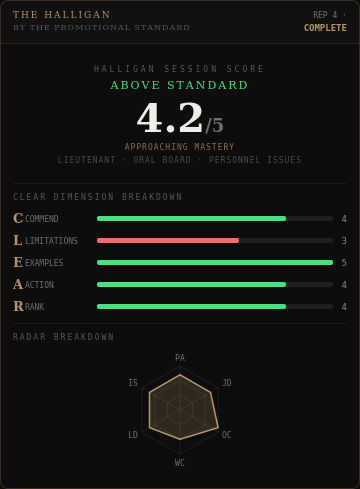
02 · YOUR SCORE
Your score.
Every response is scored against 8 behavioral dimensions — the observable leadership behaviors assessors are trained to watch for. Your feedback arrives in the CLEAR format — Commend, Limitations, Examples, Action, Rank — so you know what worked, what didn't, the one action for your next rep, and whether you operated at the rank you're testing for.
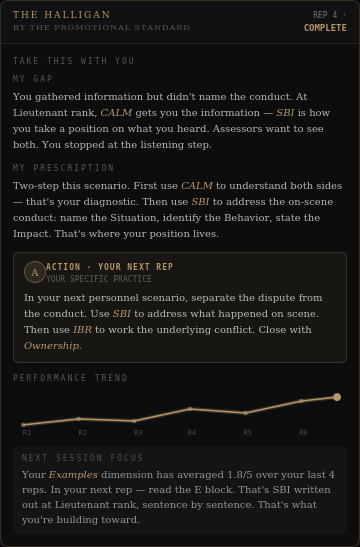
03 · YOUR PRESCRIPTION
Your prescription.
One gap. One specific thing to fix before your next rep. Not a list. A diagnosis.
The Assessment Center Intensive includes full Halligan access — a 90-day practice window.
The EMS Officer Program
One Standard.
One Program.
The complete 13-chapter EMS track — plus the full 43-chapter Fire officer curriculum it was built alongside.
The Assessment Center Intensive
One-time payment · Instant access
- · All 13 EMS-track chapters — Supervising through Executive Officer
- · All 43 Fire-track chapters — the complete TPS library
- · The Halligan practice engine — 90-day practice window
One-Time Payment · Instant Access · No Subscription Required · Used by EMS Candidates LT through Chief
Who This Is For
This Is For You.
And It Isn't For Everyone.
This Is For You If:
- →You're an EMS provider who knows the job cold and wants to prove it in a room that doesn't care how many calls you've run.
- →You're a dual-role firefighter/paramedic testing for a position where both sides of your credential matter — and you're tired of prep systems that only speak fire.
- →You're a current EMS officer who needs to test again, test higher, or finally get the promotion the field says you've already earned.
- →You've sat on a board and watched candidates fail not because they didn't know EMS — but because they didn't know how to perform EMS leadership under evaluation conditions.
This Isn't For You If:
- →You're looking for a test bank to memorize and hope the questions show up the same way.
- →You want someone to hand you answers instead of building the framework that generates them.
- →You're not willing to do reps.
The board doesn't promote the most experienced medic in the room. It promotes the one who performs like an officer.
The Standard Is Set
EMS finally has a system.
The only question is whether you'll use it.
Every candidate who walks into that room prepared the same way you did is your competition. The ones who walk in with a framework, a methodology, and a thousand reps behind them are something else.
This is the work. It's here. Start now.
One-Time Payment. Instant Access. No Subscription Required.